

The Ultimate Free NREMT Prep Guide

For EMT, AEMT, and paramedic candidates: use this free NREMT prep guide to strengthen patient assessment, clinical reasoning, question interpretation, and test-day confidence.
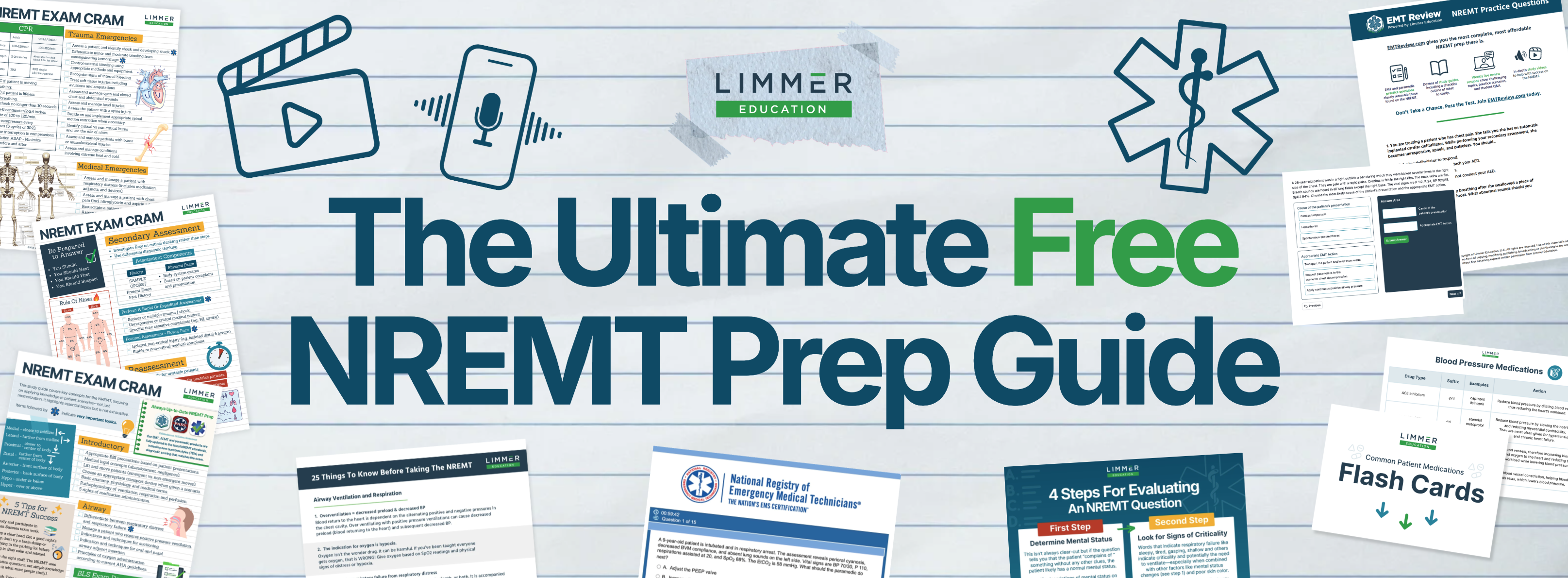
👋 Start here: How to use this free NREMT prep guide
This page is built for active exam preparation, not passive reading. Start with the 4-step question evaluation method, review the topics find difficult, then practice applying that knowledge to patient scenarios.
Using these resources will help you pass and start a new dream career.
📋 How to use this page
Learn the question-analysis approach. Use the 4-Step Question Evaluation Method to identify what the scenario is really testing.
Review the relevant content or video. Focus on the assessment finding, pathophysiology, medication class, or treatment priority behind the question.
Practice, read the rationale, and revisit weak areas. Treat every missed question as a clue to what to review next.
The most common NREMT study mistake: memorizing facts without practicing application.
The cognitive exam asks candidates to interpret a patient scenario, recognize what matters most, and choose the next priority.
🚑 What is the NREMT?
The EMT and paramedic examinations are computer adaptive tests (CAT), while examination format varies by certification level. Computer adaptive means the number of questions and difficulty of questions varies based on how well each test-taker is performing compared to the national passing standard.
The AEMT exam is linear, meaning every test-taker gets the same number and difficulty level of questions. Review the current National Registry candidate handbook for the rules, examination format, eligibility requirements, and policies that apply to your exam.
What’s in this free NREMT prep guide 👇
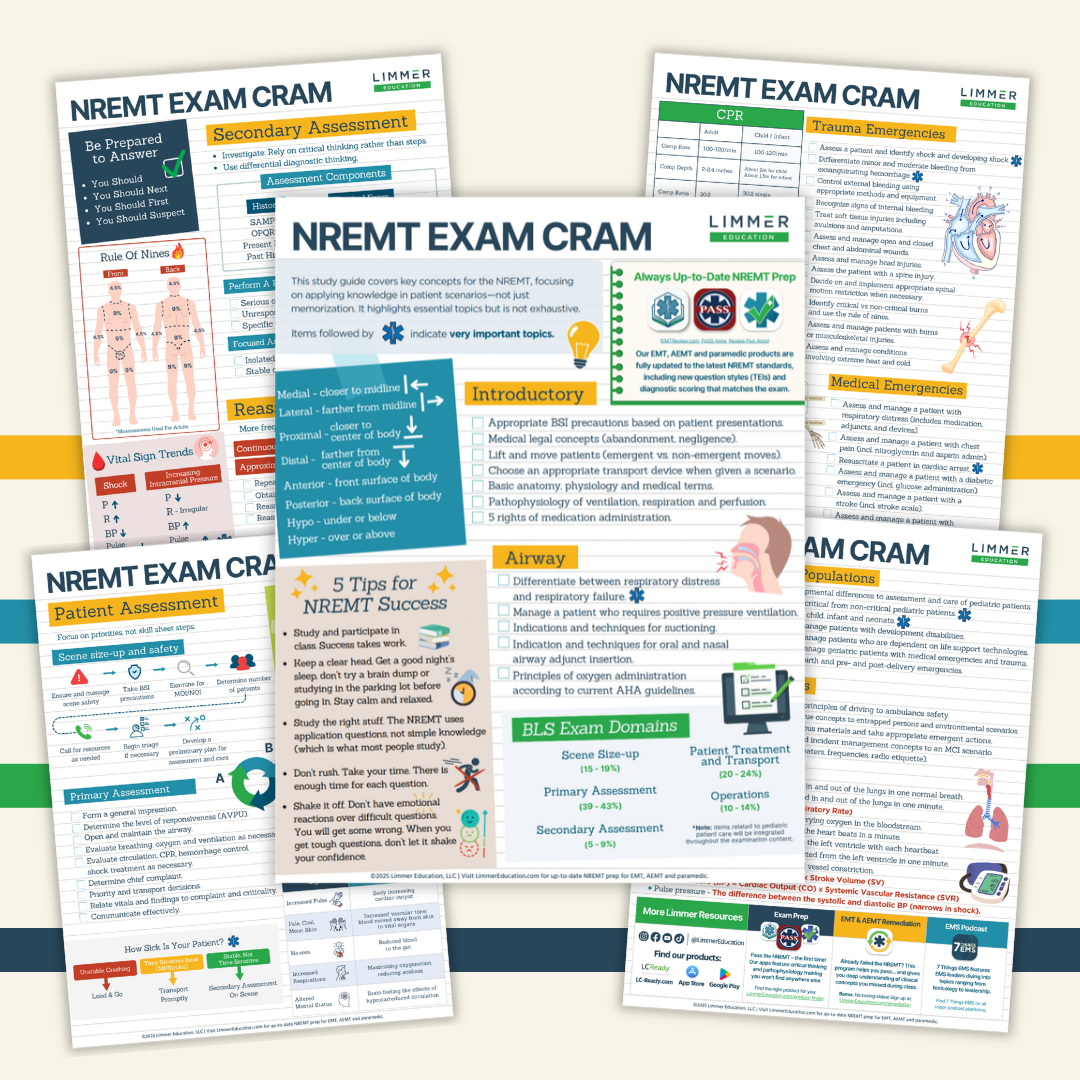
2026-2027 NREMT Exam Cram Study Guide PDF
Tried and true, this guide highlights must-know items and helps you apply your knowledge to emergency situations.
Updated for the 2026-2027 exam, it includes:
A checklist of application-based areas for EMT students to study.
Two pages of patient assessment info you must understand for the exam.
Basics of pathophysiology.
CPR facts.
Identifying shock.
Study tips for the NREMT.
Med term reminders.
Skeletal anatomy.
And more!
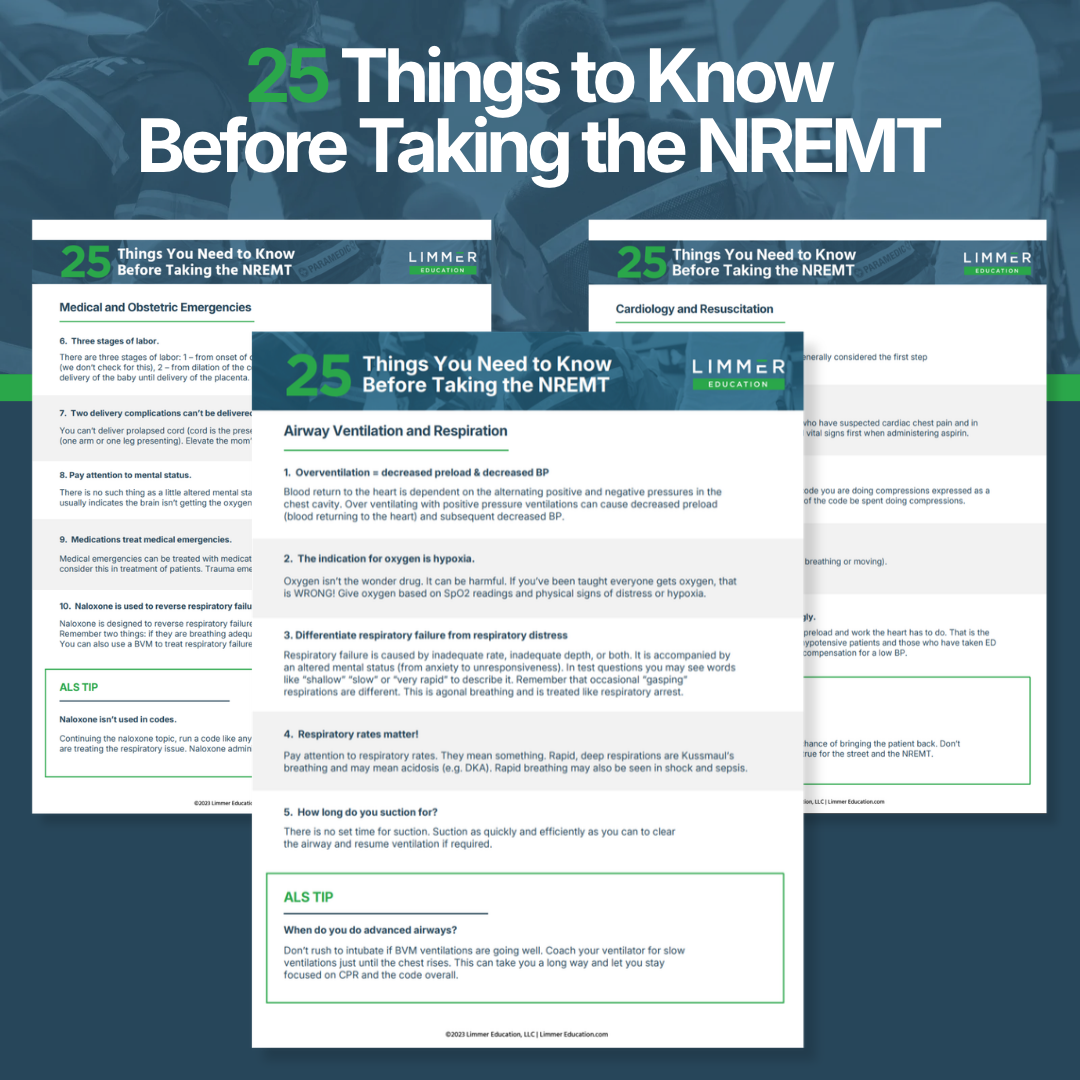
25 Things to Know Before Taking the NREMT
This study guide came from a live NREMT prep course we did, but it's so good, we're sharing it here too.
It gives you essential study points for important topics on the EMT exam, and includes pointers for the AEMT and paramedic exams too.
4-Step Question Evaluation Method
If you take one thing away from this page, it needs to be this one.
To pass the NREMT, you have to know how to read and evaluate an NREMT-style question. Depending on what your class exams were like, the NREMT question structure might be totally new to you.
Check out the 4-step process every NREMT test-taker should apply to exam scenarios.
You’ll learn:
How to identify the clinical topic being tested
How to determine exactly what the question is asking
How to recognize relevant patient clues and trends
How to identify the next priority in assessment, treatment, or transport

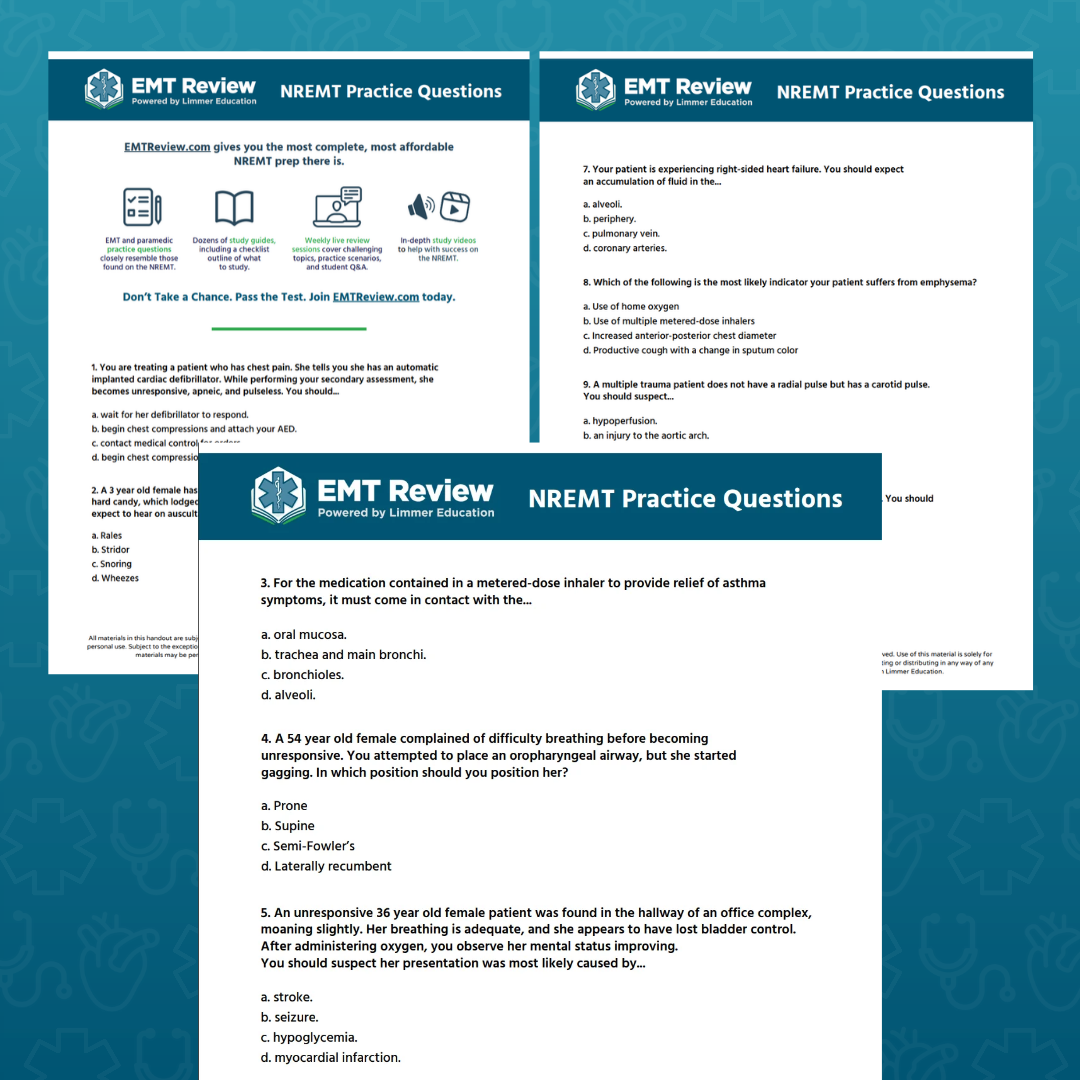
25 Free NREMT Practice Questions and Answer Key
Yep, it’s exactly as good as it sounds. These free practice questions give EMT learners scenario-based practice with major NREMT content areas, including patient assessment, airway and breathing emergencies, shock, trauma, medical emergencies, and EMS operations.
The downloadable set includes 25 questions and an answer key with rationales. Learners can identify not only what they missed but why the stronger answer is safer or more appropriate.
You’ll learn:
Clinical topics commonly tested in EMT-level patient scenarios
How to apply assessment findings to a treatment or transport decision
How to recognize common distractors in NREMT-style items
How to use answer rationales to target weak areas
📝 Free Mini NREMT Practice Test
The Free Mini Practice Test helps EMT, AEMT, and paramedic candidates become comfortable with item formats that require more than selecting one answer. Use it after learning the question-analysis method, then review every rationale to identify whether the missed step involved clinical knowledge, reading the stem, prioritization, or interpreting the item format.
Practice included
NREMT Drag-and-Drop Practice: Match, sort, or reposition information based on the clinical task.
NREMT Build-a-List Example Practice: Arrange actions, findings, or priorities in the requested order.
NREMT Option Check Box Practice: Select all options that meet the question’s criteria.
NREMT Multiple Response Practice: Evaluate each possible answer independently rather than searching for one “best” option.
NREMT Clinical Judgment Scenario Practice: Work through linked patient information to identify priorities and appropriate decisions.
NOTE: Official sample items can familiarize candidates with formats, but they are not a substitute for content review and scenario-based practice.
Try the Mini Practice Test▶️ NREMT Videos
5 YouTube Videos That Will Change How You Think
These videos are helpful for EMT and AEMT students. We have one pathophysiology that’s good for both levels.
Long question stems are not harder. They often contain the patient details needed to determine the clinical problem and priority. This lesson shows how to separate relevant assessment findings from background information, identify what the question is asking, and avoid choosing an answer before the scenario is fully understood.
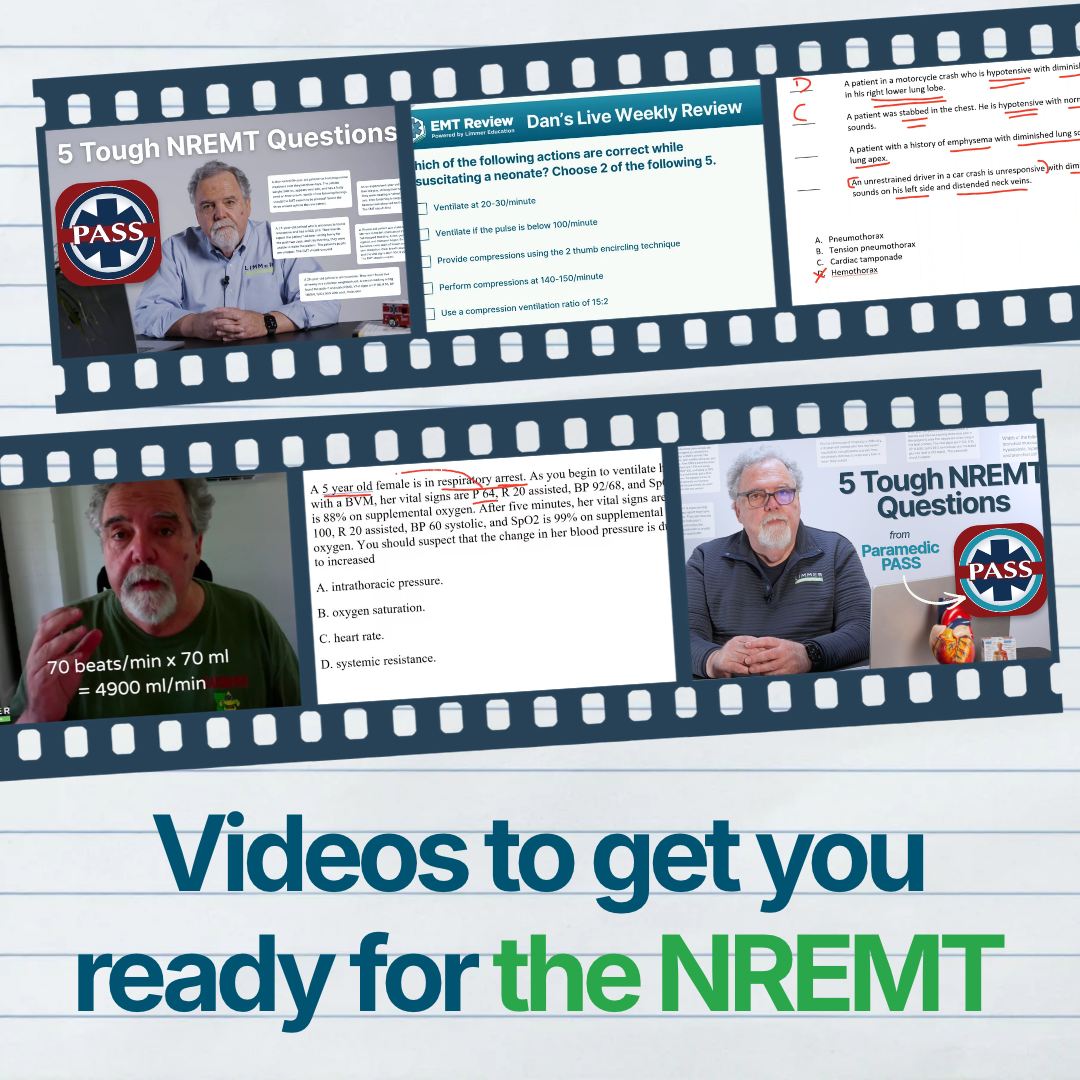
We also have 5 tough questions for paramedics to help you pass the NREMT.
This patient-matching exercise teaches learners to connect signs, symptoms, vital signs, and history with likely clinical concerns. Use it to practice recognizing patterns rather than memorizing one-to-one word associations, especially when multiple findings appear in the same question.
This review works through three distinct breathing emergencies to reinforce assessment priorities and clinical differentiation. Focus on how the patient presentation changes the most appropriate immediate action, rather than assuming every respiratory complaint receives the same treatment sequence.
Multiple-response questions require a separate judgment about every option. This video helps learners identify the question’s criteria, avoid stopping after finding one plausible answer, and select only the options supported by the scenario and EMS priorities.
Vital signs tell a story about compensation and decompensation. This five-part series explains how shock affects perfusion and vital-sign trends, how the body compensates, and why a patient can appear stable before worsening quickly. Use the series to connect pathophysiology with the assessment patterns tested on NREMT-style questions.
🎧 NREMT Audio
Sample lectures
Listen to a short playlist of sample lectures from the EMT & AEMT Review Audio Lecture apps. They’re discussion-based (not just some dude droning on and on) and bring lots of real-life examples to the conversation.
These will help boost your knowledge and your application of that knowledge for the NREMT.
Passing the NREMT Podcast
Want to study while driving or doing chores? 7 Things EMS is normally a CE podcast, but this one special 40-minute episode is all about how to pass the NREMT. Dan shares seven honest insights that will help you before and during the test.
Listen to the episode, or find it wherever you get your podcasts.
Medication Flashcards
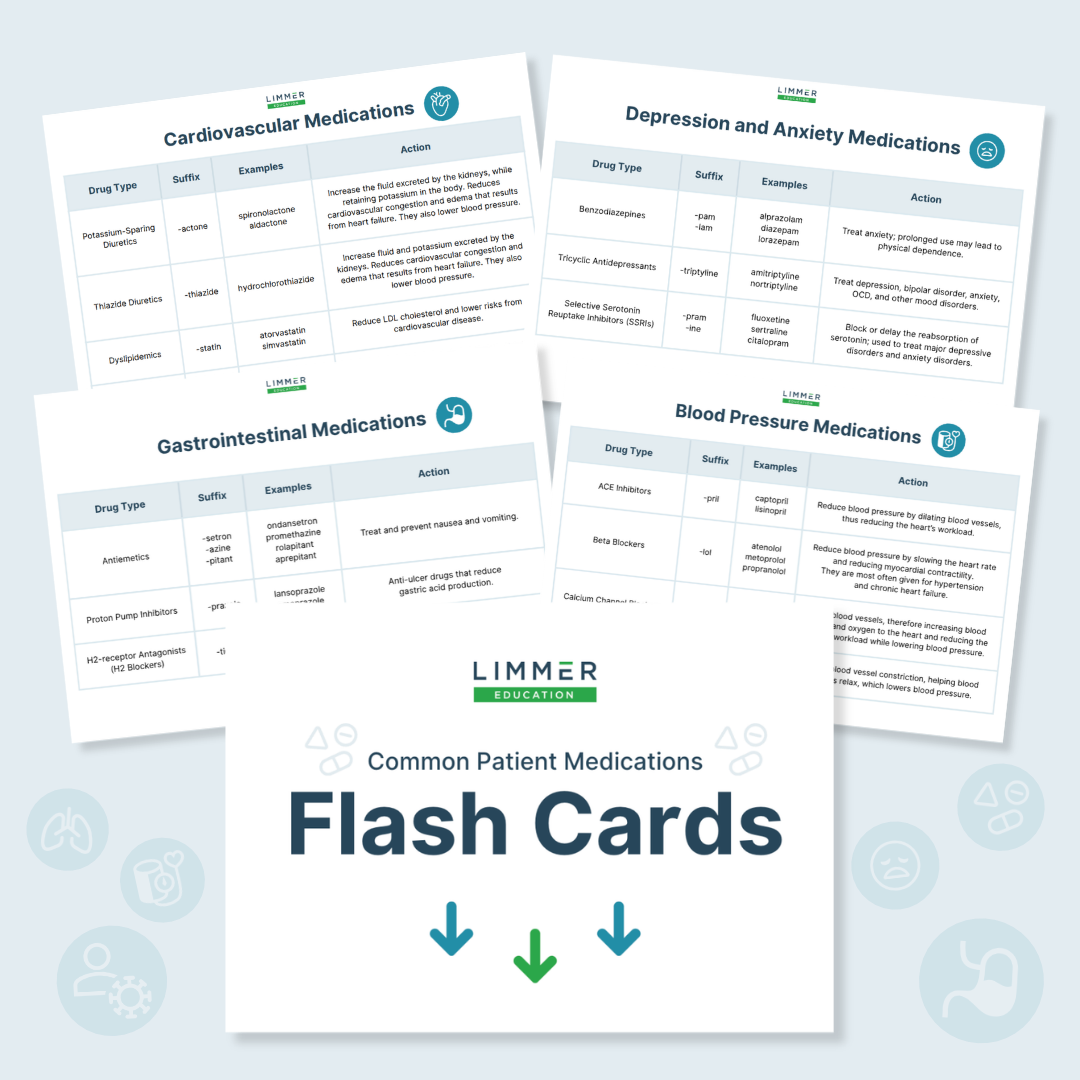
Having a hard time keeping patient medications straight? You don't have to know every medication for the NREMT, but it's good to learn how to classify medications by common suffixes.
Medication flashcards help candidates recognize common drug classes, medication-name patterns, likely indications, and clinical implications.
Knowing that a medication belongs to a beta blocker, anticoagulant, bronchodilator, diuretic, or diabetes medication class can make a history more meaningful during both field assessment and test scenarios.
You’ll learn:
How common medication suffixes can suggest a drug class
How to connect a medication list with a patient’s medical history
Which medication patterns may signal bleeding risk, respiratory disease, cardiac disease, diabetes, or altered mental status
Why medication recognition improves clinical reasoning without requiring memorization of every drug
Print and cut this free medication flashcard set and get yourself up to date with common drug types.
Download the flashcardsEMT Jeopardy-Style Review Game
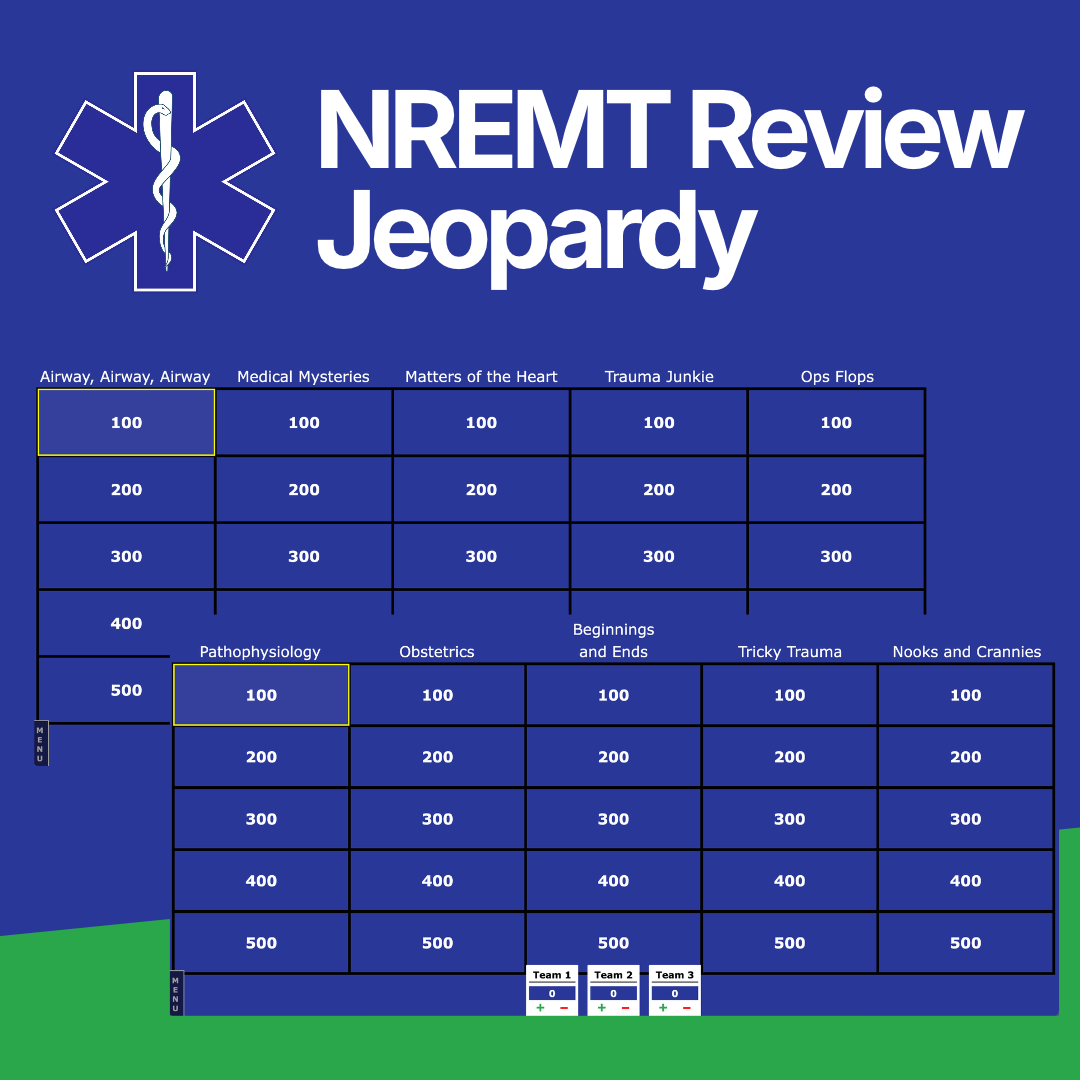
The EMT Jeopardy-style review game turns studying into a creative solo or group activity.
Complete both games to work through 50 questions across major content areas, including trauma, medical emergencies, patient assessment, and EMS “medical mysteries.”
You’ll learn:
How to retrieve key EMS knowledge under mild time pressure
How to connect categories such as trauma and medical emergencies with patient-care decisions
How to recognize gaps in recall before exam day
Why reviewing an incorrect answer matters more than simply moving to the next question
After an incorrect answer, pause and identify the clinical topic, the clue you missed, and the reasoning that supports the correct response. Then review the related guide, video, or practice set before trying a similar question again.
Official NREMT Sample Items
Official NREMT sample items are useful for learning how technology-enhanced and scenario-based formats look on screen. They are designed for format familiarity, not comprehensive studying. Combine them with content review, question analysis, and practice questions with rationales.
Per the NREMT's intro page on these tests: “These sample items are intended solely to introduce you to the different types of items you may see in the certification examination. They are not a substitute for studying. None of these sample items will appear on the actual examination.”

Recommended (But Not Free) NREMT Prep
All are fully updated for the 2026-2027 exam
If you need something a bit more comprehensive, in-depth and/or guided, check out our top-recommended apps and programs:
PASS Apps
Our famous EMT, AEMT and Paramedic PASS apps are more challenging than the NREMT itself. We did that on purpose. If you can succeed on PASS practice exams, you can succeed on the NREMT. Includes multiple response items (all levels) and performance scenarios (AEMT and paramedic).

EMTReview.com
Affordable NREMT prep program for EMT and paramedic. This site is especially good for people who struggled in class or already failed the NREMT once. High-quality questions closely resemble those found on the NREMT. Practice exams include all the NREMT's new question types!
NREMT Review Streaming Video
In two hours, learn how to analyze NREMT test questions. This video walks you through practice NREMT questions (including TEIs) and teaches you how to approach challenging questions. There’s nothing else like it!
Remediation for EMT, AEMT, or Paramedic
If you've failed the NREMT 3 times, the National Registry requires you to take a remedial course before your next attempt. Limmer Education remediation is the most comprehensive course there is. It is engaging, interactive, and you will actually learn the things you missed during class!
Start your EMT, AEMT, or paramedic remedial training program.
💬 NREMT Exam FAQs
Is the NREMT cognitive exam the same as a class final?
No. The certification examination assesses entry-level competency through clinical scenarios and applies a standardized passing standard; it is not simply a cumulative recall test from one course.
Is the EMT exam computer adaptive?
Yes. The current EMT cognitive examination is computer adaptive, meaning item number and difficulty can vary by candidate while the passing standard remains consistent.
Are AEMT and paramedic exams the same format as the EMT exam?
Not exactly. The National Registry’s current overview identifies EMR, EMT, and paramedic examinations as computer adaptive, while AEMT uses a linear computer-based format. Review the handbook for your certification level before testing.
When will I get my results?
Follow the result instructions in your National Registry candidate account and current handbook. Policies and timing can change. Use the official NREMT candidate handbook rather than relying on an outdated forum post.
What happens if I need to retest?
Eligibility and retesting requirements are governed by current National Registry policy and may change. Review the handbook for your certification level and contact the National Registry when your situation involves application status, attempts, remediation, or eligibility.
How should I study for the NREMT?
Study by practicing how to interpret patient scenarios, not by repeatedly rereading facts. Build your preparation around patient assessment, recognition of relevant clues, prioritization of the next action, and review of missed-question rationales. Practice under exam-like conditions, then return to the precise topic or reasoning error behind each missed item.
Use the 4-Step Question Evaluation Method first, reinforce weak clinical content with the EMT Exam Cram Study Guide, and apply what you learn in 25 Free NREMT Practice Questions and the NREMT New Questions Practice Test.