



Limmer Education
Proficiency in ECG interpretation skills is crucial for EMS professionals but often proves challenging due to complex waveforms and cognitive overload.
by Limmer Education
Our articles are read by an automated voice. We offer the option to listen to our articles as soon as they are published to enhance accessibility. Issues? Please let us know using the contact form.
Out on a call, you find a woman is about to have a baby, right now. It’s only you, your partner, and a lot of PRESSURE.
In a two-part 7 Things EMS podcast, host Dan Limmer sits down with Rachel Tank, an EMT program coordinator who runs what Dan calls a "legendary" hands-on training lab for delivering babies. Together, they break down the real story behind emergency births and why so many EMS providers feel nervous about them. The conversation is packed with surprising facts and practical tips.
Here are the first 7 things to learn on OB and gynecology from this two-part series:
OB Deserts Have Changed the EMS Role
Out-of-Hospital Birth is Not Rare
When OB Goes Bad, It Goes Bad Fast
Transport Time Matters
WHO 2025 PPH Guideline Clarification
Severe Hypertension & Preeclampsia
If EMS Doesn’t Train OB, OB Will Train EMS
Here's a shocker: since 2010, more than 500 hospital baby-delivery units have closed across America. That means many women now live in what experts call “OB deserts,” places where the nearest hospital that delivers babies could be up to four plus hours away.
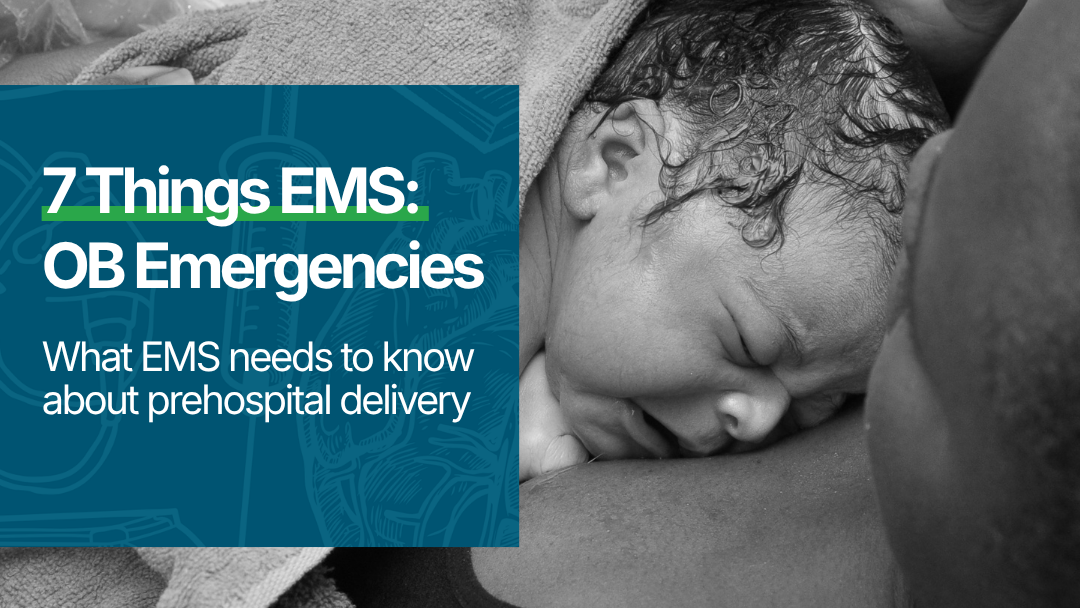
Who helps when a baby comes early and no hospital is close by? EMS. You are the safety net for moms who can't get to a hospital in time.
The problem is, delivering a baby isn't something ambulance crews do very often. In fact, it's under 2% of all their calls. Although this sounds like good news, Rachel points out something scary:
The things you do least often are usually the ones that are the most dangerous when they finally happen.
Her survey of hundreds of EMS workers found that most of them said they felt only "slightly" or "not very" confident about handling a birth.
Rachel compares emergency prep to football. Before any big game, there’s a tailgate or pregame party. When the OB call comes in, EMS providers need to pregame: Don't wait until you're standing in front of a scared mom to figure out your plan. Talk with your partner on the way. Review the steps. Figure out who does what. Make a Plan B and even a Plan C in case things go sideways. You have to walk in looking calm and confident.
When a birth goes wrong, it can go wrong quickly. The number one cause of death for moms is postpartum hemorrhage, which is heavy bleeding after birth.
When a woman is pregnant, her body makes a lot more blood, about 40-50% more than normal. That extra blood is like a hidden backup battery. It helps her body hide the fact that she's bleeding badly, sometimes until it's almost too late. A pregnant patient can lose nearly a third of her blood before anyone notices something is wrong.
That's why Rachel teaches responders to watch the patient and listen. The phrase she says is the biggest red flag of all: when a woman says, "Something isn't right. I just don't feel right." She might not be able to explain it, but that feeling is often the first warning of serious trouble.
Rachel even shares that tennis superstar Serena Williams had that exact moment after giving birth. She told the nurses something was wrong, but they didn't listen at first. It turned out she had a pulmonary embolism.
Important: Always listen.
To stop dangerous bleeding, administer oxytocin, which helps the body squeeze the bleeding to a stop, and TXA, which helps blood clot. Also, a hands-on move called a fundal massage can help. This is where you press firmly on the belly, trying to locate the hard uterus. Dig in deeply to stimulate contractions and control bleeding.
Here's the frustrating part: Rachel found that about 30% of ambulance services don't even carry oxytocin. That's like a firefighter showing up without hoses. Getting every EMS crew the right tools is one of her biggest goals.
Here are some of the tougher situations responders might face:
Shoulder trouble: Sometimes a baby's head comes out, but the shoulders get stuck. Responders learn special positions and gentle pressure to help, but the golden rule is never pull or yank. As Rachel says, “Moms deliver babies. We don't.” The responder's job is to guide, not tug.
Babies coming feet-first: Most babies come out head-first, but not all of them. When a baby is breech, EMS crews can sometimes help deliver. But if one hand or a single foot pokes out, then it's time to rush to the hospital.
Early babies: Premature babies are especially fragile and get cold super easily. Rachel teaches a surprising trick: wrapping a preemie (up to the neck, never the head) in clear plastic wrap to lock in warmth.
Heart stopping: If a pregnant woman's heart stops, you might expect the worst. But because these patients are often young and healthy, their survival rate is about 60%. Compare that to the usual survival rate for other heart-stopping emergencies, which is around 10%. Rachel says that number should give every responder hope, and a reason to fight hard for both mom and baby.
Knowing that emergency births happen isn't enough. Responders, ambulance services, and hospitals need real training, the right medicines, and a solid plan.
This article is based on the two-part "OB Emergencies" episodes of the 7 Things EMS podcast by Limmer Education, hosted by Dan Limmer with guest Rachel Tank of the National Medical Education and Training Center (NMETC). EMS professionals can earn continuing education credit for these episodes at LC-ready.com.
Limmer Education
Proficiency in ECG interpretation skills is crucial for EMS professionals but often proves challenging due to complex waveforms and cognitive overload.

Limmer Education
You don’t have to pre‑study before EMT class. But you definitely can. It could make those first few weeks feel a lot less overwhelming.


Dan Limmer, BS, NRP
Understanding pathophysiology transforms guesswork into informed, patient-centered decision-making.