



Limmer Education
Most EMT students do not struggle on the NREMT because they lack effort, they struggle because their study methods do not match the exam.
by Limmer Education
Our articles are read by an automated voice. We offer the option to listen to our articles as soon as they are published to enhance accessibility. Issues? Please let us know using the contact form.
EMS educators don’t need more test questions; they need better ones. When you move from “define shock” to “identify signs of shock” to “choose the most appropriate intervention,” you’re changing how a student thinks.
This is a practical guide about how to write your EMS questions so that your exams test practice, not simply memorization.
Let’s start with a single concept: shock.
“Which of the following best defines shock?”
This tells you whether the learner can repeat the line from the textbook. Useful, but doesn’t prepare them for the NREMT.
“An adult involved in a high-speed MVC is pale and cool, with a BP of 88/56, HR 124, RR 28, and delayed capillary refill. Which of these should an EMT suspect?”
Now the student must recognize the pattern of shock from data, not a definition.
“A pale, cool adult trauma patient has a BP of 88/56 and HR 124. Which of these is the most appropriate initial intervention?”
The learner applies pathophysiology to a treatment decision.
Same topic, three different questions.
When your exam questions focus on Levels 2 and 3, you certify clinicians.
Great multiple-choice items are focused: one central idea, one correct response.
One concept per item
Don’t ask about mechanism, assessment, and intervention in one stem. Pick one task: suspect, choose, interpret, or evaluate.
Have only one answer
If two options could be defended, the problem is your writing, not the student.
Spend time writing the stem
A student should have a good sense of the answer from the stem alone. A well-written stem gives students enough information to recognize the problem, prioritize, and anticipate the correct action before they read the answer choices.
Weak stem
A 68-year-old man has chest pain and shortness of breath. What is the most appropriate treatment?
This stem is too broad and the clinical picture is incomplete.
Improved EMS stem
A 68-year-old man reports sudden-onset substernal chest pressure that began 25 minutes ago while carrying groceries. He describes the pain as “heavy,” rates it 8/10, and says it radiates to his left arm. He is pale but alert. His vital signs are blood pressure 154/88 mm Hg, pulse 96/min and regular, respirations 18/min, and SpO₂ 96% on room air. Which of the following interventions should the EMT perform?
This stem provides enough information for the student to make an informed decision.
Put scene details, vital signs, history, and physical exam findings in the stem. Then ask the learner to suspect a condition, choose an intervention, or predict a response.
Avoid “teaching” in the stem
“Insulin is necessary for the body to use carbohydrates…” is a mini-lecture, not a stem. Instead ask, “Which of these is characterized by a total lack of insulin secretion?” and let the options do their work.
No missing clues in options
If the learner needs a piece of information to discriminate between choices, it belongs in the stem, not in a distractor.
Edit your work. Long questions make exam questions frustrating to the test taker.
Only add what’s necessary
Remove extra adjectives, adverbs, and unnecessary information.
Simple, direct sentences
“What is the most appropriate initial action?” is clear.
Remember who you’re testing
Poorly written items often measure reading level more than they measure EMS knowledge and judgment.
Negative stems and options can confuse test-takers and drag down item quality.
Prefer positive wording
Ask “Which intervention is indicated?” instead of “Which of these is NOT indicated?” whenever possible.
For example, avoid stems such as these:
Which action should the EMT avoid?
Which action would be the most dangerous error?
Which action should the EMT not take?
Your distractors determine whether the item really discriminates between prepared and unprepared students.
Make distractors similar in length and structure
When the right answer is the only long or technical option, you’ve given it away. Have the distractors all be similar in style, terminology, and complexity.
Use common misconceptions as distractors
Wrong-but-plausible answers based on typical student errors are good; they separate learners who genuinely understand from those who don’t.
Avoid opposites
Don’t list “tachycardia” and “low blood pressure” as separate distractors if your stem already suggests hypotension; avoid two options that mean essentially the same thing, as that lets students knock both out at once.
Yes, they’re easy to write. But they’re not good for learning.
“All of the above”
If one option is clearly wrong, you’ve eliminated “all of the above.” If two options look right, test-wise students will guess “all of the above” even without really understanding the concept.
“None of the above”
In EMS clinical questions, none of the above often measures whether the student can recognize the correct answer, not whether they understand the concept.
“Always,” “never,” “completely”
These are giveaway words; test-wise students know that absolute statements are usually false. Clinical medicine rarely deals in absolutes.
Avoid trick questions entirely
Double negatives and “gotcha” are just bad. They don’t improve exam validity.
Rule 7: Keep It Clinically Relevant
EMS exams create knowledgeable EMS personnel.
Test high-frequency and high-criticality knowledge
Focus on concepts that are used often or have serious consequences if done incorrectly (e.g., airway, shock, trauma, cardiac care, and obstetrics.)
Every item should match clinical guidelines
Each question should have an identifiable source you can cite.
Stay noncontroversial and within scope
Don’t test something that is contentious in the field.
When you sit down to build your next EMS exam for your class, you might try this quick checklist based on EMS item-writing guidance:
Did I use concepts (like shock, airway, and trauma) and change them from simple definition questions to more assessment and intervention questions?
Does each question test one concept, with a single correct answer?
Is the essential clinical information in the stem?
Have I edited the stem down so I’m testing knowledge, not reading ability?
Did I avoid negative stems, absolutes, “all/none of the above,” and trick formats?
Are my distractors plausible, similar in length and style, and free of obvious clues?
Is every item clinically relevant, noncontroversial, and supported by course references or accepted standards.
If you can say “yes” to all of these questions, you’re creating students who can think for the NREMT.
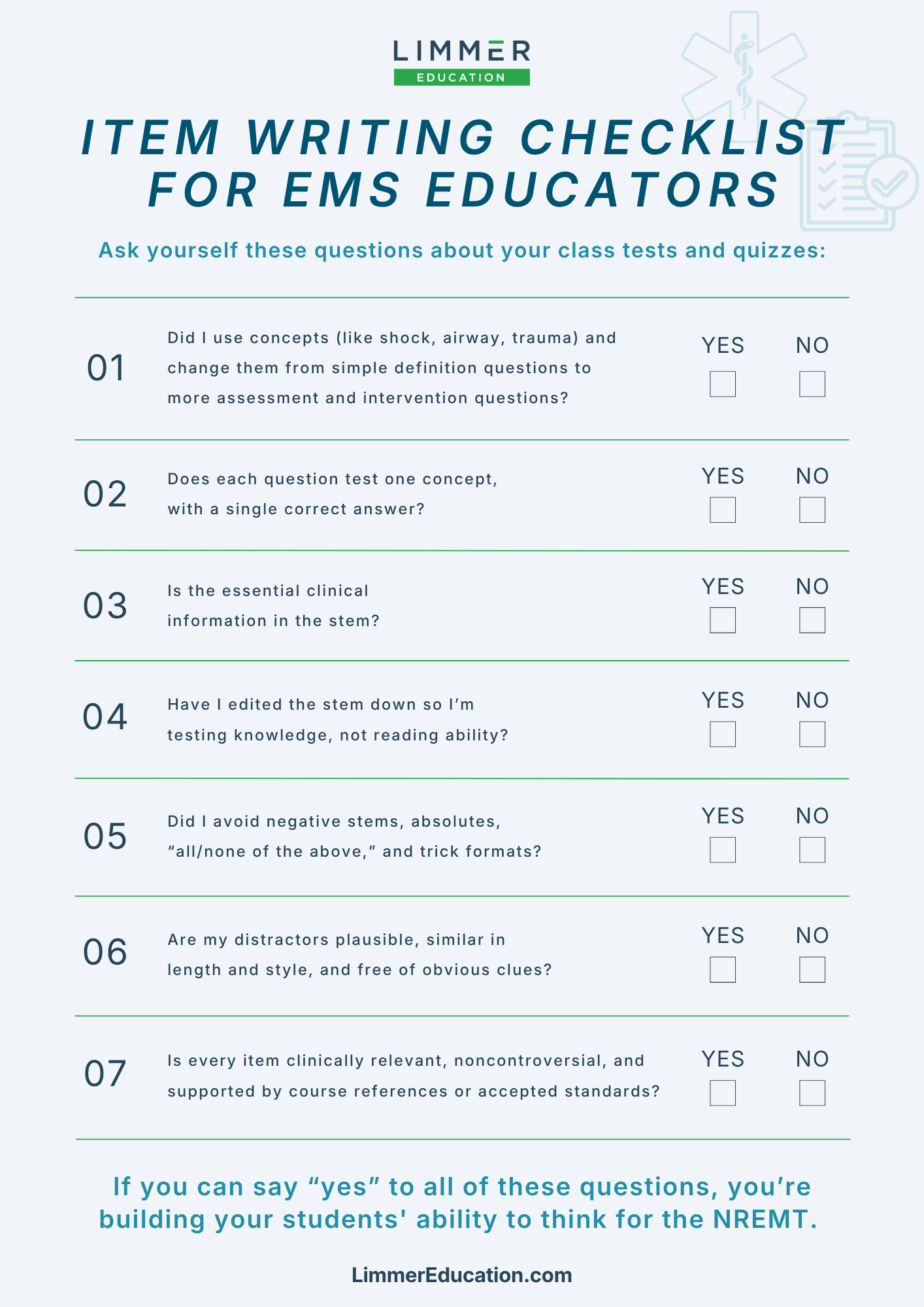
Download the Item Writing Checklist for EMS Educators.
Q1: What is the most important rule for writing EMS multiple‑choice questions?
A: The most important rule is to test one concept per item and ensure there is one clearly best answer. This keeps questions focused and improves the validity of EMS exams by measuring specific knowledge or clinical reasoning.
Q2: How can EMS educators make exam questions more clinically relevant?
A: Use realistic patient scenarios, vital signs, and scene details in the stem, and link each question to accepted EMS standards. Focus on high‑frequency and high‑risk topics such as airway, shock, trauma, and cardiac care so the exam reflects real‑world practice.
Limmer Education
Most EMT students do not struggle on the NREMT because they lack effort, they struggle because their study methods do not match the exam.

Limmer Education
Get the latest EMS guideline changes impacting trauma care, resuscitation, and education nationwide.

Limmer Education
How did we get from one NREMT prep app to where we are today? Take a look at 15 years of Limmer – and 15 years of changes in EMS.