
Limmer Education
Find the right Limmer EMT prep tools to match your learning style and pass the NREMT.
by Limmer Education
Our articles are read by an automated voice. We offer the option to listen to our articles as soon as they are published to enhance accessibility. Issues? Please let us know using the contact form.
Most side hustles come with a catch, from startup costs to deep learning curves to a realization that you now own a ring light and understand what drop-shipping means. The barrier to side hustles is often time, energy, and figuring out where to start.
Or, you can choose a job that uses knowledge you already have.
If you're an EMT or paramedic, you can parlay your expertise into a flexible side gig as an adjunct teacher or change career paths completely and become a full-time educator. You get to earn extra money, share your skills with the next generation of prehospital caregivers, and keep your day (or night) job.
Interested? Here's one way to start:
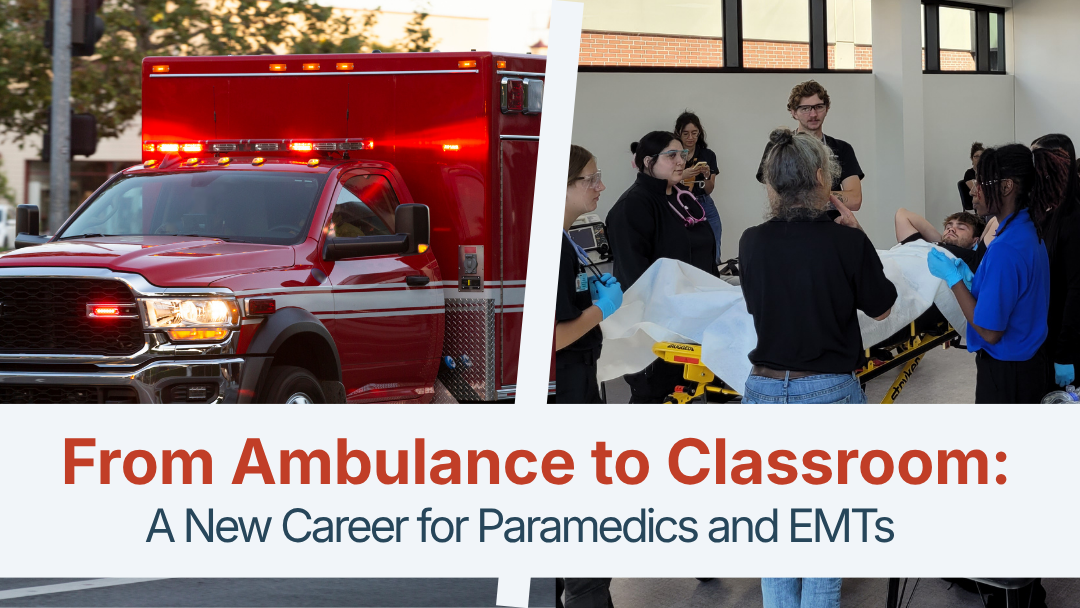
You don't need to jump into teaching classes all on your own or even quit your EMS job. You can take a phased approach, which could help you build confidence in speaking in front of students.
"New educators most often begin by assisting with skills classes, acting as a skills instructor, skill evaluator, or adjunct instructor, while continuing to work in the field," says J. Todd Vreeland, Product and Continuing Education Manager of Limmer Education. “You start out helping with the skills classes, and then typically from there you can step up into doing lectures and then becoming an instructor.”
This step method aligns with the “crawl, walk, run” that instructors often use as they move into the education field: coach during the crawl phase (skills instructor), provide information in the walk phase (lecturer), and teach a full course during the run phase (full-fledged educator).
Skills instructors demonstrate and guide students through procedures, which could include airway management (BVM, suctioning, advanced airways), IV/IO, medication administration, patient assessment, or trauma care.
You demonstrate and help students understand how best to perform critical skills.
When moving into the position of lecturer, you explain EMS care by using patient scenarios, explaining clinical decision-making, and highlighting patterns students see in the field. This education allows students to move beyond memorization and into critical thinking.
As an educator, you might prepare the entire curriculum and perform work outside of the classroom. This could include anything from preparing classroom slides and activities to creating assessments to responding to student questions outside of class hours via email, texts and having open office hours.
Vreeland says, “If you’re going to teach a topic, you need to be as informed about that topic as the students, if not more so." This includes taking instructor development courses focused on adult education and taking the NREMT every two years to stay aware of question modifications.
Education is a calling and not for everyone. You should know the challenges of the profession before you decide this is a path you want to take. For example, keeping course content current is a persistent problem. Guidelines (such as those from the American Heart Association) can change every year, and you should keep abreast of updates to teach current science.
To battle such challenges, Vreeland recommends engaging with professional resources, such as the National Association of EMS Educators (NAEMSE), which offers members access to the latest prehospital emergency care literature. Prehospital Care Research Forum (PCRF) has monthly webinars and recordings to keep you up to date on evidence-based research.
Student NREMT exam success often depends on test-taking strategies and familiarity with exam priorities. You don't have to figure this out on your own. Recommendations to help facilitate coursework include:
EMT Class Advantage, designed to offer curriculum support and training for busy educators.
LC-Ready platform, which delivers top-tier study materials to students and streamlines class tracking and reporting.
EMTReview.com is a well-rounded program for topical review and NREMT prep. It reinforces what EMT and paramedic students learn in your classroom.
Due to the demanding nature of education, turnover among instructors is high. For your best chance of success in this field, you can seek opportunities locally at the programs where you trained, pursue instructor development (Vreeland highly suggests listening to the Limmer Education podcast "We Are EMS Educators" and taking courses by Heather Davis, Director of Student Assessment at the David Geffen School of Medicine), pursue mentorship and continuing education, and build confidence by taking an entry-level instructor exam so you understand what your students must know.
Although education sounds like a lot of work, it is a path worth seeking if you want to inspire future EMS and paramedic professionals, get out of the ambulance, and have set hours. It is a different kind of intrinsic motivational work that comes with many rewards.
Limmer Education
Find the right Limmer EMT prep tools to match your learning style and pass the NREMT.


Dan Limmer, BS, NRP
With ongoing updates from the American Heart Association, the NREMT exam is changing by emphasizing current science.

Limmer Education
Death is not always a failure, but it can feel like one. In EMS, you’re trained to act, to fix, to save. Not every call ends up with a positive outcome.