



Limmer Education
You don’t have to pre‑study before EMT class. But you definitely can. It could make those first few weeks feel a lot less overwhelming.
by Limmer Education
Our articles are read by an automated voice. We offer the option to listen to our articles as soon as they are published to enhance accessibility. Issues? Please let us know using the contact form.
SITUATION: You find a patient slumped forward, barely responsive, making wet and gurgling respirations, and see vomit pooling in their mouth. Seconds matter. You need to act fast. What do you do?
This is one of the high-stakes moments that you will encounter as an EMT. You must get the patient oxygen asap. Suctioning is the intervention that can best lead to a positive outcome in this scenario.
Suctioning removes blood, vomit, mucus, and debris blocking the airway. Such secretions, if left in the mouth, can cause hypoxia or get pushed down into the lungs during ventilation. Suctioning can create a clear airway that allows for oxygen delivery.
In short, suctioning is vital to life.
Suctioning education now focuses less on specific rules (such as what you find with CPR training), and instead, is more patient-specific. These are the guidelines to keep top of mind:
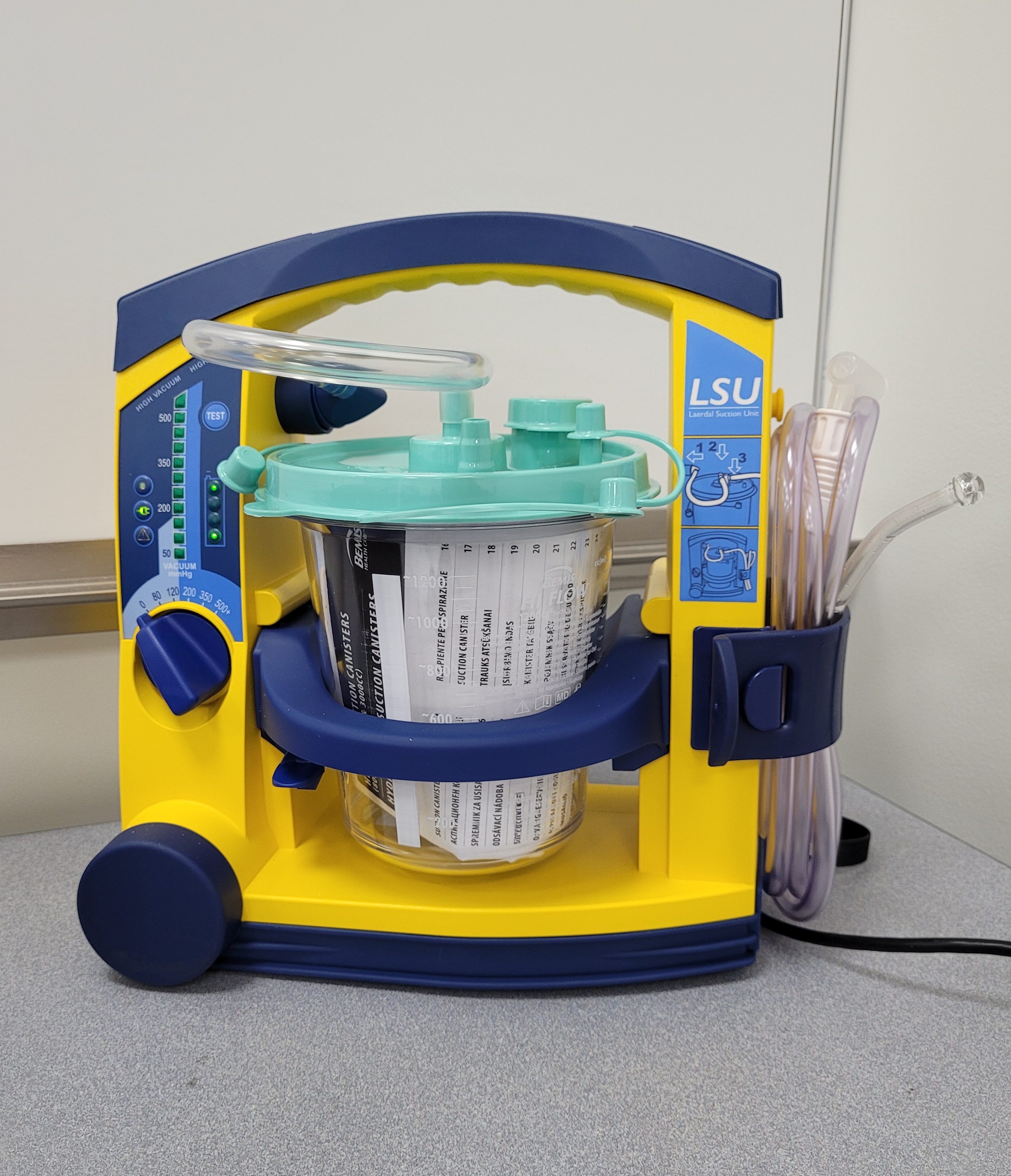
Suction until the airway is clear. Then move on to ventilation and oxygenation.
Too much suctioning increases hypoxia. Stop as soon as it’s clear.
Ventilating vomit into the lungs can lead to aspiration pneumonitis, even days later.
Do not follow a stopwatch or the previous 15-second rule. Suction quickly until you remove any objects and secretions. Then immediately ventilate and oxygenate.
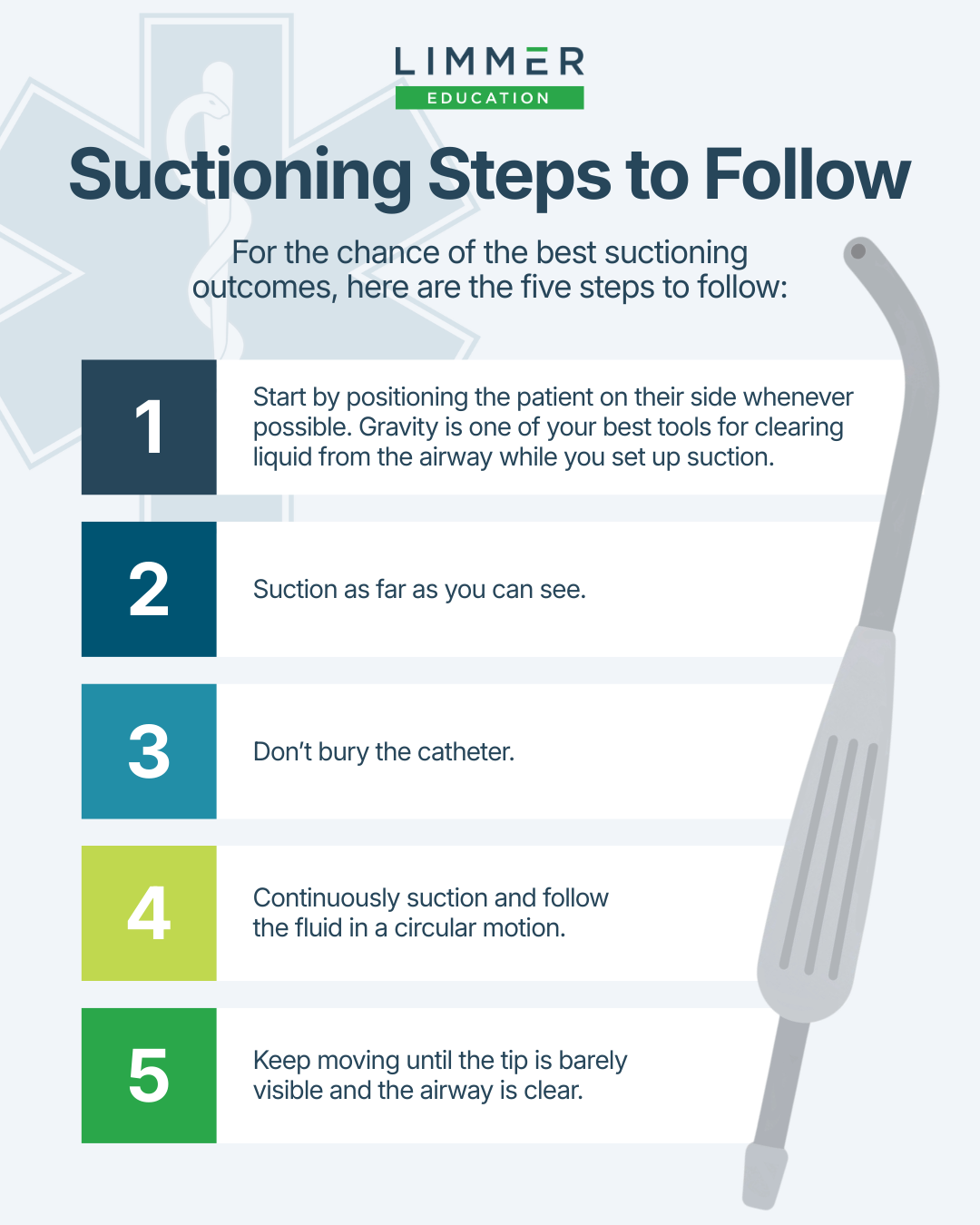
For the chance of the best suctioning outcomes, here are the five steps to follow:
Start by positioning the patient on their side whenever possible. Gravity is one of your best tools for clearing liquid from the airway while you set up suction.
Suction as far as you can see.
Don’t bury the catheter.
Continuously suction and follow the fluid in a circular motion.
Keep moving until the tip is barely visible and the airway is clear.
You’ll encounter different catheter types during your EMT career, such as rigid Yankauers for the mouth, large bore catheters for more heavy secretions, and small French catheters for children or tubes. You must familiarize yourself with all types.
IMPORTANT: Know your equipment. Practice with it. Speed comes from familiarity.
Ideally, you want to roll the patient onto their side to help drainage and reduce aspiration. But emergencies aren’t always ideal. Sometimes you can roll and oftentimes you can’t. You need to use situational judgement.
TAKEAWAY: When you’re with a patient who can’t breathe, suctioning is vital. Practice often to achieve competency. We have to think on our feet and make appropriate decisions in less-than-ideal situations.
Review your understanding of suctioning and other critical skills: EMT Review Plus includes flashcards, practice exams, and a mental conditioning section to train you to think like an EMT.
Limmer Education
You don’t have to pre‑study before EMT class. But you definitely can. It could make those first few weeks feel a lot less overwhelming.

Limmer Education
Learn how to write better EMS multiple-choice questions that assess clinical judgment, not just memorization.
Limmer Education
EMS is always changing. How do educators keep up with teaching for all the changes?