



Limmer Education
What if there was a dependable way to get correct, relevant, scope-specific, well-explained EMT answers, 24/7?
by Limmer Education
Our articles are read by an automated voice. We offer the option to listen to our articles as soon as they are published to enhance accessibility. Issues? Please let us know using the contact form.
While the release of the American Heart Association guidelines stirs debate in EMS education and practice every 5 years, the science behind everything we do is constantly evolving.
Consider the following position papers released by NAEMSP over the past year. Some of their conclusions may surprise you, and you may wonder how it impacts your teaching. Let’s take a look.
• This position paper recommends vented chest seals (commercial or three-sided) and states that occlusive dressings shouldn’t be used in open chest wounds where ventilation is necessary.
• This position paper doubles down on the idea that we shouldn’t transport on backboards and goes one step further, casting doubt on whether we should use cervical collars at all.
• This position paper appears to equalize the use of traction splints and fixation splints in terms of femur fractures and states something we’ve always suspected: that a fractured mid-shaft femur is relatively rare, especially where there are no additional fractures or joint injuries that would contraindicate the use of traction.
• This position paper says that pelvic injuries are elusive and difficult to identify accurately, and that pelvic binders are frequently misused. Securing the legs together with proper limb alignment may constitute reasonable care. It also casts a bit of doubt on the amount of bleeding that may occur during pelvic trauma, encouraging examination for bleeding in other parts of the body when shock is present.
• This position paper doesn’t believe epinephrine should be used in traumatic out-of-hospital cardiac arrest (TOHCA) and begins to explore whether chest compressions should be used at all.
Do any of these papers immediately invalidate anything you teach or what is presented in your textbook? No. Will your protocols change immediately? Probably not. But you shouldn’t ignore it either.
The purpose of this post is to give you a heads-up on some of the current thinking and recommendations. Not everything here is carved in stone. No one is saying to stop delivering compressions to trauma patients immediately, never use a traction splint again, or that c-collars are evil. (OK. Maybe c-collars are…)
Now that you’ve seen the papers, here are a few tips on digesting them for your personal use as well as determining your teaching approach to changing science and recommendations.
Reading this article is a start. If you aren’t a member of NAEMSE, you should join. A significant member benefit is free access to the Prehospital Emergency Care journal, where you can find papers and research that are always relevant to EMS. If you have a membership (which is good for more than just the journal), but haven’t looked recently, now is the time.
Keeping an eye on research and position papers means you won’t be surprised when more definitive recommendations come down.
After reading the position papers we provided above, look at the references they cite to support their positions. This practice will provide educators with background knowledge, reasoning, and interesting talking points.
Intuitively, it makes sense that ventilating a patient with a sealed chest wound may cause a tension pneumothorax and that the beneficial sympathetic effects of epinephrine may be limited in many traumatic situations. (Actually, epinephrine and its relation to ROSC and long-term survival in any OHCA are dubious at best.) How do we know this? A&P and pathophysiology. Use that in your explanations. We fail to provide depth when it would help our students understand, and are somehow afraid to teach that depth.
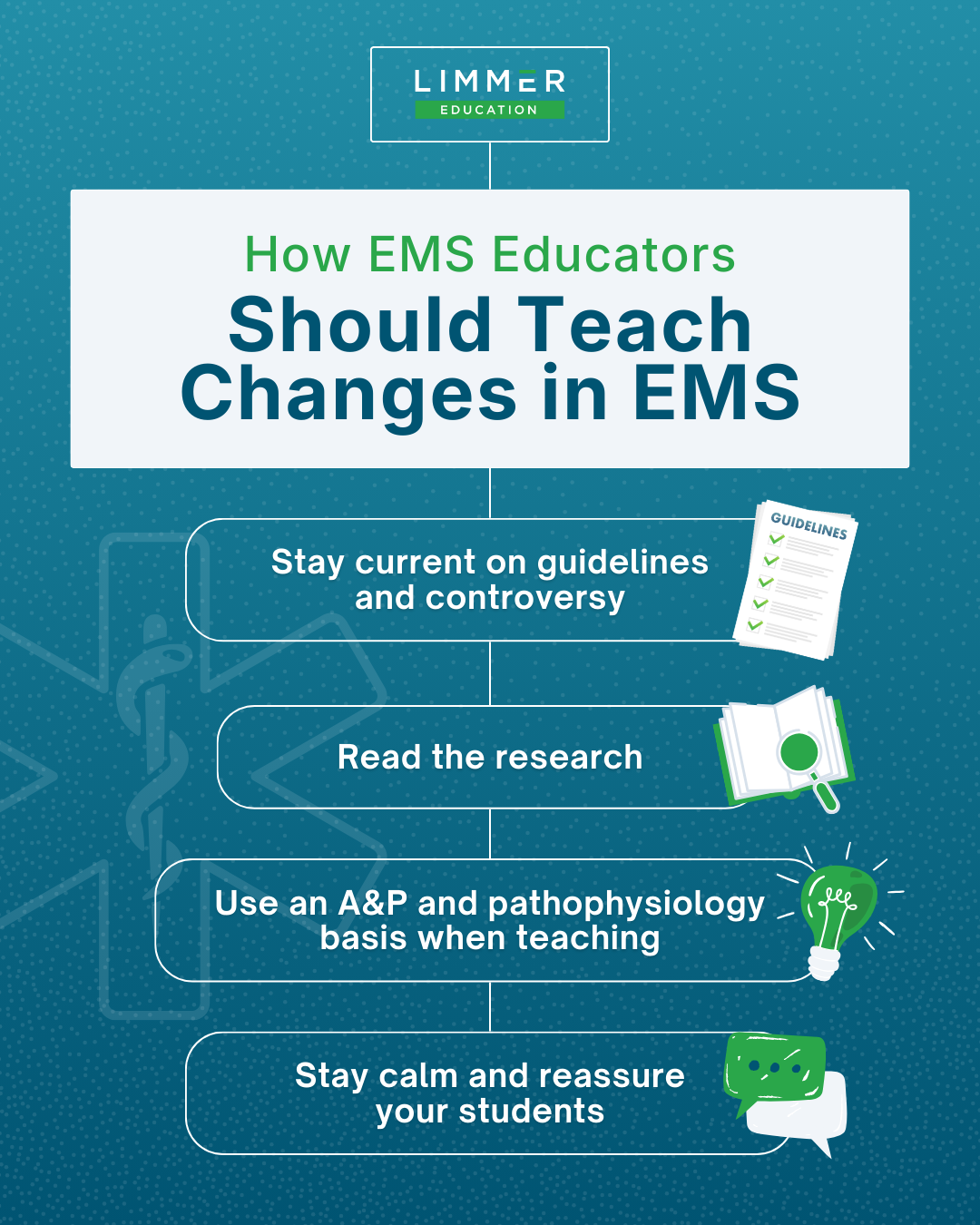
It will be OK. Honestly. When EMS began, EMT and paramedic texts rarely needed revision. There was minimal research and strong mantras that guided us. Science wasn’t pervasive, and things didn’t change at the pace they do now. We’ve turned that around so much that we shed mantras and want solid science. Science that changes frequently.
The NREMT is aware of these papers and the AHA guidelines and removes questions that conflict with the new guidelines. Many times, questions are created with this in mind. For example, the NREMT is more likely to ask what drug or drug class is indicated in a specific situation than what dose of a drug is indicated, due to differences in recommendations and protocols.
We are in a time of significant change. We’ll keep you updated on changes. Let us know what you think of some of the changes we’ve listed in this article. Do you agree? Will this change the way you teach or the content you present? Let us know in the comments below.
Limmer Education
What if there was a dependable way to get correct, relevant, scope-specific, well-explained EMT answers, 24/7?

Limmer Education
In a two-part 7 Things EMS podcast, Dan Limmer and Rachel Tank break down the real story behind emergency births.

Limmer Education
If you're an EMT or paramedic, you can parlay your expertise into a flexible and potentially lucrative side gig.