



Limmer Education
Failing the NREMT doesn’t end your calling to become a paramedic. Diagnose why, adjust, and persist.
by Limmer Education
Our articles are read by an automated voice. We offer the option to listen to our articles as soon as they are published to enhance accessibility. Issues? Please let us know using the contact form.
EMS science and guidelines are constantly changing. The science changes more frequently than textbooks are updated, and many practitioners don’t even find out about changes right away.
Are you aware of what’s changed in EMS recently? To keep up to date, one of the best places you can look for new research is the National Association of EMS Physicians (NAEMSP).
Here we’ll review the American Heart Association (AHA) updates, along with shifting trauma care guidelines from NAEMSP.
For educators: The Emergency Care, 15th Edition textbook is regularly updated and all of these updates have already been added to the text.
This pdf provides a summary of these changes.
The American Heart Association’s (AHA) 2025 update introduces four updates that are critical for EMT and paramedic instruction.
Back blows (also known as back slaps) are reinstated for responsive adults and children with severe or complete foreign body airway obstruction (FBAO). The updated sequence is five back blows followed by five abdominal thrusts, repeated until the object is dislodged or the patient becomes unresponsive. This sequence aligns more closely with long-standing ILCOR and Red Cross guidance.
For educators: Update exams and reinforce the full sequence in skills practice. This change simplifies inconsistencies students might have already encountered.
Naloxone might now be considered in suspected opioid-related cardiac arrests but only after high-quality CPR is underway and without interrupting compressions or ventilations. Routine use of naloxone in all codes is not recommended.
For educators: Consider adding questions that involve prioritizing steps in a code and include naloxone. A build-a-list TEI question would be ideal here, as it would give students additional exposure to that type of question.
The AHA is placing more importance on post-resuscitation communication and team debriefing.
For educators: Practice how to communicate effectively after a code. Tie it in to the introductory and resuscitation chapters, including cardiac arrest lab stations.
Several minor changes were introduced or reinforced:
Delayed cord clamping (≥ 60 seconds) remains recommended.
Ventilation rate adjusted to 30-60/minute.
Two-thumb compression method preferred universally. If a patient’s size prohibits this, compress with the heel of one hand.
Supraglottic airways are indicated in neonatal resuscitation if EMTs are allowed to use them and have access to neonatal sizes.
For educators: Consider expanding time spent on neonatal care, which often gets less attention late in the course.
Five recent position papers from the NAEMSP offer insight into where trauma care may be heading.
Accuracy of pelvic trauma identification and effectiveness of binders is experiencing growing skepticism. If binders are used, they should be placed over the trochanters and the legs should be internally rotated by securing the feet together.
For educators: Focus on anatomy, especially differentiating “hip” from “pelvis.” Make sure students understand proper application of binders.
Traction splinting might be on its way out, with increasing support for simpler fixation methods. Isolated mid-shaft femur fractures are rare–so use of the traction splint is also rare. We aren’t as good at skills we use infrequently.
For educators: Continue teaching traction splints where required but introduce students to other perspectives and alternatives.
Chest seals are no longer recommended when we ventilate a patient with an open chest wound. If an occlusive dressing is used, a vented seal is preferred over an unvented one.
An interesting note about this paper is that it says that 3-sided dressings aren’t recommended, but continues on to recommend “a thin, dry, adherent dressing” with no further explanation. We believe the 3-sided dressing is more in the spirit of the vented dressing than the 4-sided alternative. Vented commercial chest seals may be preferred, but we know that enough blood will clog any seal. Being observant for developing tension pneumothorax is the best medicine.
For educators: Reinforce pathophysiology and make sure students can identify a developing tension pneumothorax. When students understand the “why,” they can make better decisions on the exam and in the field.
Epinephrine is no longer recommended in traumatic out-of-hospital cardiac arrest, and future discussions might even remove compressions.
For educators: Teaching foundational physiology is necessary, especially the role of the sympathetic nervous system.
Traditional longboard immobilization is definitively out, and even spinal motion restriction is being re-evaluated. Some agencies are switching to soft collars, or (GASP!) no collars.
For educators: Prioritize thorough spinal assessment and decision-making. Expect continued movement toward less restrictive approaches.
We can tell you that the e-text and subsequent paper printings of Emergency Care, 15th Edition, have been updated to include these changes. From integrated clinical updates such as the above to enhanced decision-making tools that include new flowcharts and scenario-based learning, both the e-text and paper textbook are designed to help educators stay current without constantly reinventing their course.
This pdf provides a further summary of these changes.
In addition, Limmer Education provides classroom solutions and educator resources as a value-add to your course.

EMT Class Advantage: From structured lesson plans and engaging videos to realistic case studies and interactive activities, everything in EMT Class Advantage is designed to supplement what you already teach. You also get the benefit of ongoing support from Dan and the Limmer Education team, helping you stay current on these clinical updates.
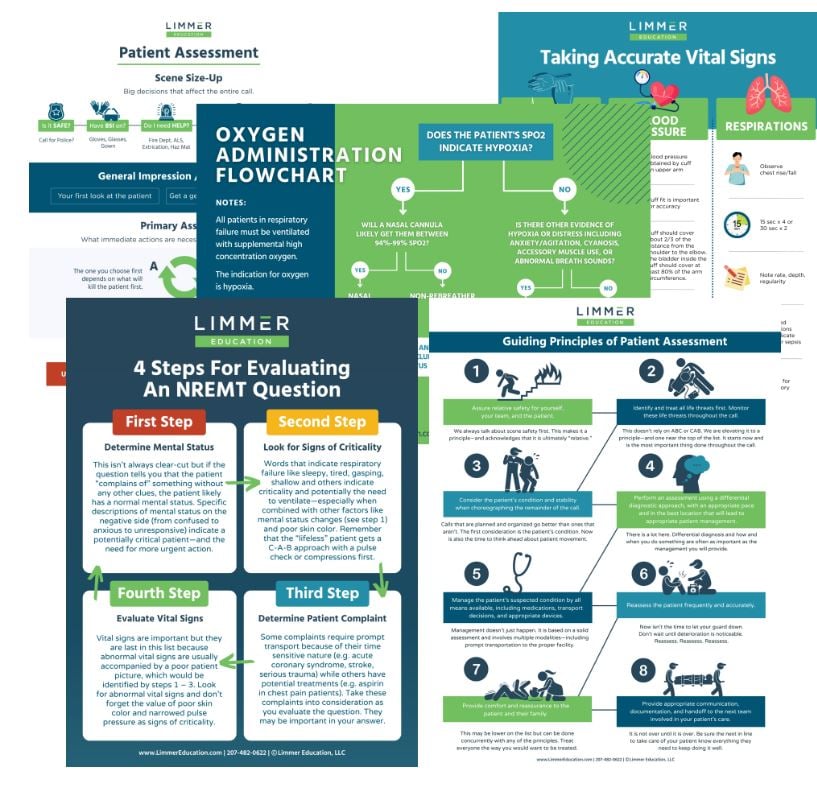
Classroom posters: Vibrant, high-quality clinical posters are designed to educate and motivate students, and you can display them throughout the classroom. We’ve transformed our most popular flowcharts that provide clear, step-by-step guidance on topics such as oxygen administration, patient assessment, spinal motion restriction, and NREMT preparation.
Limmer Education
Failing the NREMT doesn’t end your calling to become a paramedic. Diagnose why, adjust, and persist.

Limmer Education
You don’t have to pre‑study before EMT class. But you definitely can. It could make those first few weeks feel a lot less overwhelming.
Limmer Education
EMS is always changing. How do educators keep up with teaching for all the changes?
I have said this before, and I am saying it again. Limmer provides excellent, up-to-date information, and the way you share it with direct links is greatly appreciated! Thank you!
This marks year 46 for me as a paramedic. Every few years I'm fascinated by the changes in pre-hospital care. Often things we used to do fall out of favor, and then years later, are recommended again. It's a challenge, sometimes, to keep up. Always an adventure.