



Limmer Education
Failing the NREMT doesn’t end your calling to become a paramedic. Diagnose why, adjust, and persist.

by Dan Limmer, BS, NRP
Our articles are read by an automated voice. We offer the option to listen to our articles as soon as they are published to enhance accessibility. Issues? Please let us know using the contact form.
As much as there are traditional differences in communication between men and women, there is a similar disconnect between the American Heart Association and the EMS community. It is never more evident than when the AHA guidelines are released every five years.
This year, guidelines have raised the ire of the EMS community, especially regarding mechanical CPR (aka the Lucas device).
The American Heart Association states this in their guidelines:
2025 (Updated): The routine use of mechanical CPR devices is not recommended for adult cardiac arrest. 2025
(New) In adult cardiac arrest, the use of mechanical CPR devices may be considered in specific settings where the delivery of high-quality manual compressions may be challenging or dangerous for the health care professionals, as long as they strictly limit interruptions in CPR during deployment and removal of the device.
Let’s read this statement through the lens of a physician and an EMS provider:
Physician: “Hmmm. My system doesn’t always have all the people we need to run a code, and the LUCAS is necessary to get the job done. We will use it if we do it right, train frequently, minimize delays, and ensure the device doesn’t slip.”
EMS provider: “The AHA is trying to take away our $#&%* LUCAS!”
See where we are going with this? Mars and Venus. Different people interpret the same document differently.
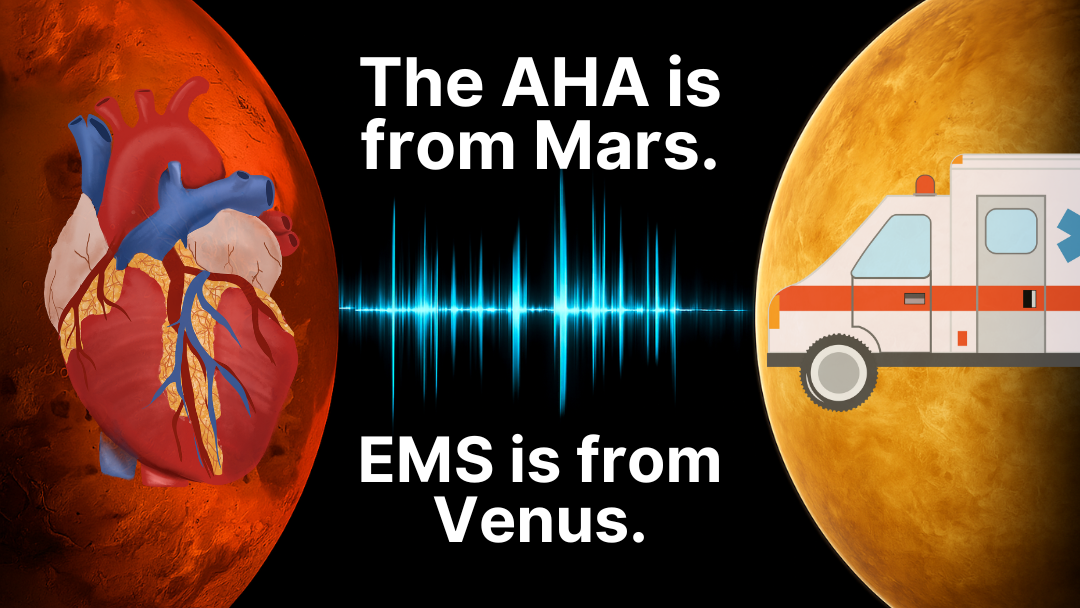
The American Heart Association guidelines apply to in-hospital and out-of-hospital environments, but the document's language and application speak more to hospital clinicians.
We acknowledge that EMS providers may interpret the guidelines differently. We also appreciate the dedicated EMS personnel involved in guideline development. EMS does have a seat at the table. However, the guidelines fail to account for the differences in practice location and the needs of EMS providers. They just don’t speak to us.
Does this mean that the guidelines are invalid for us? No. It means that we need to change our approach to interpreting them. We need to look at the second part of the guidelines, which says, “...the use of mechanical CPR devices may be considered in specific settings where the delivery of high-quality manual compressions may be challenging or dangerous…” and say, “Hey! That is us!”
Does this mean that the guidelines are invalid for us? No. It means that we need to change our approach to interpreting them.
EMS can’t broadcast a code and have team members from all over the ED and hospital descend on a well-stocked, bright, and controlled bay. We are pumping and blowing in a cramped bedroom or a dangerous street corner, hoping the engine company will show up quickly. Or worse yet, have a two-person crew with minimal hope of getting help.
This being said, we aren’t victims. We are talented, proud clinical providers who make a difference in survival from out-of-hospital cardiac arrest. We need to step up our science game, do our own research that reflects our unique environment, and take the guidelines slightly less personally.
And you can keep your LUCAS. Honest.
Limmer Education
Failing the NREMT doesn’t end your calling to become a paramedic. Diagnose why, adjust, and persist.

Limmer Education
Learn how to interpret your score, create a remediation plan, and use targeted study tools to pass your NREMT.

Limmer Education
The NREMT EMR exam isn’t about knowing every answer. It’s about knowing what to do first when a patient needs help.
I said this from the start. They are not recommending for or against. They surely could have worded it better.